Membership plans only work when the structure fits the patient. A single flat plan either over-serves your low-risk patients or under-serves your complex ones. The fix is segmentation — building a small range of plans around one clear logic, so each patient finds the one that suits them and your team can explain it in a sentence.
Below are six ways to segment, each with an example plan set you can lift straight off the page. Every plan here is an illustrative shape, not a price list. The prices, inclusions, visit counts and discounts are examples — copy the structure, then add, remove and re-price to fit your patients, your costs and your local market. ADA item numbers are shown next to each procedure so you can map it to your fee schedule.
How the treatment discount works. The member discount is not a system-wide price cut. You run two price lists — your standard (private) fees and a member fee schedule. Members are billed from the member list; the gap between the two is the discount, and you set the percentage (it can differ by plan or by procedure). The figures below, marked *, are illustrative.
Segment by clinical risk
The most clinically defensible model: match recall frequency and cleans to how much care a patient actually needs. Easy to justify to a patient — and to a regulator.
Low risk $5/wk | Standard $9/wk ★ | High risk $13/wk | |
|---|---|---|---|
Best for | Healthy, stable bite | Most adults, average risk | Gum disease, smokers, diabetics |
Exam (011/012) | 1/yr | 2/yr | 2/yr |
Scale & clean (114) | 1/yr | 2/yr | 4/yr |
OHI (141) | 1/yr | 1/yr | 2/yr |
Fluoride (121) | — | 1/yr | 2/yr |
X-rays — bitewing (022), OPG (037) | Bitewings | Bitewings + OPG 2-yrly | Bitewings + OPG 2-yrly |
Emergency consult (013 — consult only, no treatment) | 1/yr | 2/yr | 2/yr |
Oral-cancer screen | ✓ | ✓ | ✓ |
Treatment discount | up to 10%* | up to 10%* | up to 10%* |
Assign each patient to a tier from their caries and periodontal risk at the exam, and move them between tiers as that risk changes — a high-risk patient whose gums stabilise can step down to Standard. Scaling visits to risk keeps the plan clinically honest and the economics sustainable: you are not giving four cleans a year to someone who needs one, or starving a periodontal patient of the maintenance they actually require.
Segment by treatment / care pathway
Build plans around the journey a patient is on. Ideal for high-value, maintenance-heavy patients who keep coming back for the same kind of care.
Preventive $9/wk | Perio $13/wk | Ortho retention $10/wk | Cosmetic $12/wk | Rehab / Implant $13.50/wk | |
|---|---|---|---|---|---|
Best for | General upkeep | Active/maintenance gum disease | Post-braces/aligners | Aesthetics-focused | Full-arch / implants |
Exam (012) | 2/yr | 2/yr | 2/yr | 2/yr | 2/yr + implant review |
Scale & clean (114) | 2/yr | 3–4/yr perio maintenance | 2/yr | 2/yr | 2/yr, incl. opposing arch |
OHI (141) | 1/yr | 2/yr | 1/yr | 1/yr | 1/yr |
Fluoride (121) | 1/yr | 1/yr | 1/yr | — | 1/yr |
X-rays — bitewing (022), OPG (037) | Bitewings | Bitewings | Bitewings | Bitewings | OPG yearly |
Special inclusion | — | Perio charting | Retainer checks + replacement discount | Annual whitening top-up + free cosmetic consult (013) | Implant maintenance + peri-implant check |
Treatment discount | up to 10%* | up to 10%* | up to 10%* | up to 10%* | up to 10%* |
These plans work best as the maintenance wrapper that begins when active treatment ends — the moment a patient finishes their aligners, settles their implants, or completes a course of periodontal therapy. Framing the plan as protecting the work they have just paid for makes the value obvious, and it keeps high-investment patients in regular care rather than drifting away once the big treatment is done.
A hygienist-led plan
Some practices run a plan built around the hygienist or oral health therapist — preventive visits only, at a lower price point. It suits prevention-focused patients and keeps the hygiene chair productive. It covers care within the hygienist's scope (cleans, OHI, fluoride, sealants, periodontal maintenance) — not dentist treatment like fillings or extractions, where members simply get the standard member discount.
Hygiene Essential $5/wk | Hygiene Plus $7/wk ★ | Hygiene Intensive $10/wk | |
|---|---|---|---|
Best for | Healthy mouths, regular cleans | Prevention + maintenance | Periodontal maintenance |
Scale & clean (114) | 2/yr | 3/yr | 4/yr |
OHI (141) | 2/yr | 3/yr | 4/yr |
Fluoride (121) | 1/yr | 2/yr | 2/yr |
Fissure sealants (161) | — | as needed | as needed |
Perio maintenance | — | — | ✓ (within cleans) |
Oral-cancer screen | ✓ | ✓ | ✓ |
Treatment discount | up to 10%* | up to 10%* | up to 10%* |
A hygienist plan is as much an access and chair-utilisation play as a clinical one: it fills the hygiene book, gives price-sensitive patients an affordable entry point, and creates a natural referral path to the dentist when a problem is spotted during a visit. Keep the inclusions within the hygienist or oral health therapist scope of practice, and make sure your usual dentist-examination arrangements still apply so the plan stays compliant.
Segment by value (good / better / best)
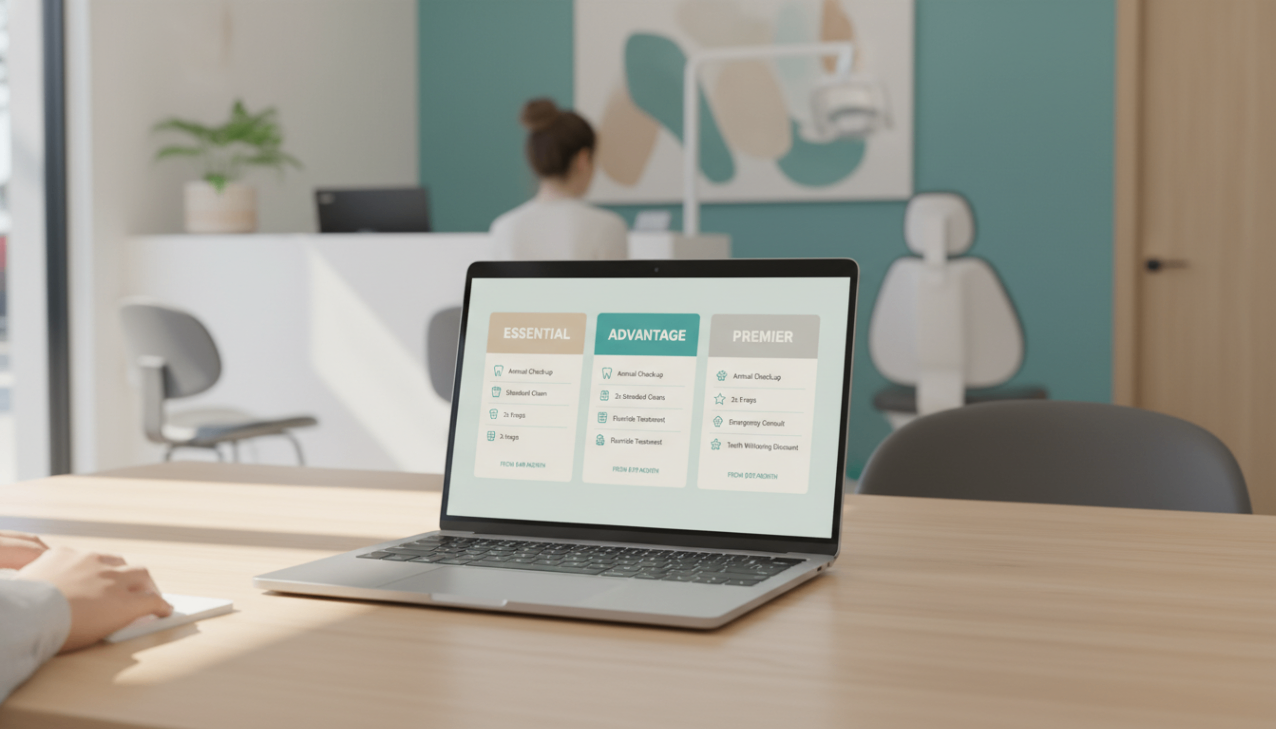
Same patient type, tiered by depth of inclusions. The simplest model to sell, and the middle tier anchors the choice.
Essential $5/wk | Standard $9/wk ★ | Premium $14/wk | |
|---|---|---|---|
Best for | Budget / minimal cover | Most patients | Maximum-value seekers |
Exam (012) / clean (114) | 1 / 1 | 2 / 2 | 2 / 2 + hygienist |
OHI (141) | — | 1/yr | 2/yr |
Fluoride (121) | — | 1/yr | 1/yr |
X-rays — bitewing (022), OPG (037) | Bitewings | + OPG 2-yrly | + OPG + intraoral photos |
Emergency consult (013) | — | 1/yr | 2/yr + priority |
Whitening | member rate | — | 1 top-up/yr |
Fillings | — | — | special member discount |
Major dental — implants, crowns/veneers | — | — | special member discount |
Treatment discount | up to 5%* | up to 8%* | up to 10%* |
This is classic three-tier anchoring: most patients choose the middle option, the Premium tier makes Standard look reasonable, and the Essential tier captures budget-conscious patients who would otherwise not join at all. Keep the jump between tiers meaningful — each step up should add something a patient can clearly see and want — and resist adding a fourth or fifth tier, which only slows the decision down.
Segment by household
One plan covering more than one person, at a per-head discount. Lifts volume and retention, and lowers your per-patient acquisition cost.
Individual $9/wk | Couple $16/wk | Family $24/wk | Add-a-dependent +$4/wk | |
|---|---|---|---|---|
Covers | 1 adult | 2 adults | 2 adults + up to 3 kids | Extra family member |
How it works | Standard plan | 2× individual − 10% | Adults' plan + kids' preventive | Added to any plan |
Best for | Solo patient | Partners | Households with children | Growing families |
Household plans are a retention and acquisition lever as much as a discount: when a whole family is on one plan, changing dentists means moving everyone, so loyalty climbs — and a single front-desk conversation can enrol several patients at once. Bill the household to one payer to keep admin simple, and decide up front how dependent children are handled when they reach adulthood so the plan does not quietly leak value.
In SmilePass, household and dependent structures are set up in Settings — you attach dependents to a plan there.
Reward loyalty (lifecycle pricing)
Better value the longer a member stays. Lowers churn and rewards the patients who cost the least to keep.
Year 1 | Year 2 | Year 3+ | |
|---|---|---|---|
Treatment discount | up to 5%* | up to 8%* | up to 10%* |
Price | Standard | Locked (no increase) | Locked + loyalty rate |
Perks | — | — | Priority booking + annual whitening top-up |
The aim is to reward the patients who are cheapest to serve and most likely to refer, and to make renewal the obvious choice rather than a moment to shop around. The escalating perks cost very little but visibly change the renewal decision, especially when the price is locked while everyone else is going up. Decide your qualifying rule — continuous membership, no missed payments — and apply it consistently so the loyalty tier feels earned.
SmilePass handles this manually today: create each loyalty tier as its own membership, then move members up by hand as they qualify — there is no automatic time-based upgrade.
Adapt, do not just copy
Treat all six as starting shapes. Pick one primary logic so patients are not overwhelmed — most practices lead with risk or value — then layer one or two extras, such as a hygienist plan or a family option, on top. Price every inclusion against your own costs before you publish, and keep the plan list short enough that your front desk can explain it without a script.
How SmilePass helps you build these
SmilePass lets you create each plan as its own membership, set its inclusions and member fee schedule, and attach dependents through Settings. Loyalty upgrades are done by moving a member to a higher tier manually, so you stay in control of who qualifies and when.
Frequently asked questions
Do I have to use these prices and discounts?
No. Every figure here is illustrative. Set your own inclusions and percentages from your costs and local market.
How is the member discount actually applied?
Through two price lists — a standard (private) schedule and a member schedule. Members are billed from the member list; the difference is the discount, and you decide the percentage.
Does the hygienist plan include fillings or other dentist treatment?
No. It covers preventive care within the hygienist's scope. Members get the standard member discount on dentist treatment.
How do loyalty upgrades work in SmilePass?
Manually — you create each tier as a membership and move members up as they qualify. There is no automatic time-based upgrade yet.
Written by Cristian Dunker, BDS, dentist (oral rehabilitation), with MBAs in Marketing (Sociesc-Brazil), Project Management (FGV-Brazil) and Finance (Bond - QLD).